
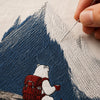
Dense embroidery looks beautiful, but what does it actually feel like to wear? A straightforward look at the weight, structure, breathability and craft behind SunnySass Sunlit Peaks.
THE SUNLIT JOURNAL · CRAFT & FEEL
A million stitches sound impressive. But what do they actually feel like on your back?
By Sunny • 7 min read • August 2026

The embroidery is the design — not a thin layer printed on top of it.
Let’s start with the answer people actually want.
Yes, the back embroidery has weight.
Sunlit Peaks is not meant to feel like a paper-thin printed summer tee. The mountain artwork is built from dense stitching, and you can feel that structure when you pick the shirt up and when you wear it.
We think that is worth saying clearly, because “premium embroidery” should not be code for pretend you can’t feel it.
“If your number-one priority is the lightest possible T-shirt, this probably isn’t the one. If you like texture, craft and a back design with real presence, that’s where it starts to make sense.”
01 / WHERE THE WEIGHT COMES FROM
A Print Sits on Fabric. Embroidery Builds Something Into It.
With a printed graphic, color is applied to the surface of the shirt. Embroidery works differently: thread repeatedly passes through the fabric to create shape, texture and density.
Sunlit Peaks uses a large back composition with mountains, landscape details, the small traveler, and selected UV-reactive areas. Building that scene takes more than a million stitches across the design.
That amount of thread does two things at the same time: it creates the tactile surface we wanted, and it adds structure that a simple printed tee does not have.

Close up, the artwork is less like an image and more like a surface.
02 / WHAT IT FEELS LIKE
You Feel It Most as Structure, Not as a Weight Pulling You Down
The easiest way to describe the feeling is “more substantial.” The embroidered area does not drape exactly like the unembroidered parts of the shirt. It has more body and holds its shape more clearly.
When the shirt is hanging, you can see that the back panel has presence. When you put it on, that translates into a more structured feel across the upper and middle back.
For most people, the sensation is less “this is heavy” and more “this does not feel like a basic graphic tee.”
Think of it this way
Printed Tee
Lightest
Flattest
Small Embroidery
Some texture
Little structure
Sunlit Peaks
Dense texture
Noticeable structure
03 / SUMMER REALITY
Is Dense Embroidery Hot in Summer?
Compared with a completely plain or lightly printed T-shirt, the embroidered area is less breathable. There is simply more material concentrated on the back.
That does not mean the whole shirt suddenly behaves like a jacket. Most of the garment is still the base fabric. But if you are standing outside in very hot, humid weather, you may notice the embroidered section more than you would on a minimal tee.
We would rather tell you that before you buy it than describe dense embroidery as magically weightless.
When we like wearing it most
• Mild sunny days
• Morning or late-afternoon walks
• City days with indoor / outdoor transitions
• Spring, early summer, and early fall when sunlight is strong but heat is manageable

The shirt makes the most sense when you actually move between shade and sun.
04 / WHY WE KEPT IT ANYWAY
We Could Have Made It Lighter. We Chose Not To.
Every product is a set of trade-offs. More embroidery adds visual depth, but also weight. A larger back graphic creates more impact, but also more structure. A simpler printed design would have been easier to produce and easier to forget.
We kept the dense embroidery because the artwork needed to work before the UV effect ever appeared. If the shirt only became interesting after stepping into direct sunlight, we would have considered the design unfinished.
In the shade, it still needed texture, craft, and a reason to turn around for a second look.
05 / THE UV PART
The Color Change Is Only One Layer of the Craft
Selected mountain details use UV-reactive thread. Indoors or in shade, those areas appear pale. In stronger natural sunlight, they shift toward a soft gold.
But the reactive thread does not replace the rest of the embroidery. The majority of the scene remains permanent, which is exactly what creates the contrast between the “before” and “after.”
We like thinking of sunlight as the final stitch you cannot see until you go outside.

In shade: finished. In sunlight: one more layer appears.
06 / FIT CHANGES THE FEEL
A Little More Room Can Make Dense Embroidery Feel Better
Because the back panel has more structure, fit matters. A very close fit keeps the embroidery nearer to the body and makes you more aware of it. A regular or slightly relaxed fit gives the back more room to hang naturally.
If you normally like a straightforward regular fit, your usual size is the simplest place to start. If you prefer a looser streetwear look — or simply want more space around the embroidered back — sizing up can make sense.
The right answer depends less on a “correct” fashion rule and more on how you personally like a T-shirt to sit.
07 / CARE
Dense Embroidery Likes a Little Patience in the Laundry
You do not need to treat the shirt like museum clothing, but the embroidered surface benefits from gentler care than a plain tee.
• Turn it inside out before washing.
• Wash gently at or below 30°C.
• Avoid bleach and harsh detergents.
• Do not aggressively rub or scrub the embroidered area.
• Air dry in the shade whenever possible.
08 / WHO SHOULD SKIP IT
This Tee Is Not for Everyone — and That’s Useful to Know
You may want something else if you only enjoy ultra-light, barely-there T-shirts. The same is true if you live in extremely hot, humid weather and want the maximum possible airflow across your entire back.
But if you like embroidered clothing, tactile graphics, oversized back artwork, or pieces that feel more substantial than a standard print, the extra structure may be part of what you enjoy.
We would rather help the wrong customer decide not to buy it than convince everyone that every product is perfect for them.
Quick Answers About the Embroidery
Is the back embroidery heavy?
It is noticeably more substantial than a printed graphic and adds structure to the back of the tee.
Is the whole design hand embroidered?
The main artwork uses precision machine embroidery, with selected UV-reactive areas receiving additional hand-finished detailing.
Does all of the embroidery change color?
No. Only selected mountain areas are UV-reactive. The permanent and reactive threads work together to create the contrast.
MORE THAN A PRINT
The extra weight is real. So is the texture, the depth, and the reason we chose embroidery in the first place.
SUNLIT PEAKS
See the Embroidery Up Close
Dense mountain embroidery, selected UV-reactive thread, and a soft-gold transformation that appears when sunlight finds it.
Discover Sunlit Peaks →Want the story behind the sunlight-reactive design?
Read: Why We Made a T-Shirt That Changes Only When the Sun Finds It →Or read the bigger idea behind the brand:
Read: A Little Sunshine Magic You Can Wear →Master the Light. Honor the Night.
Blog posts
-
, by Author Article title
-
, by Author Article title
-
, by Author Article title