
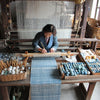
1,000,000 Stitches: A Day in the Life of a Su Embroidery Master
5:30 AM. The sky over Suzhou is still dark when Master Chen sits down at her workbench. She switches on a warm LED lamp, threads a needle with silk so fine it's almost invisible, and begins.
By the time the sun comes up, she'll have placed roughly 8,000 stitches. By the time the shirt is done — and this is just one shirt — she'll have placed over a million.
This isn't a metaphor. A single SunnySass UV-Reactive Suzhou Embroidery T-Shirt contains approximately one million individual hand stitches. Each one is placed by a skilled artisan using techniques that have been passed down for generations.
Let me walk you through what that actually looks like — because the number sounds abstract until you see the process.

The Morning Ritual
Master Chen has been embroidering since she was seven. That was thirty years ago. She started by watching her grandmother, then copying simple stitches on scrap fabric, then progressing to increasingly complex designs under her grandmother's watchful eye.
By sixteen, she could execute all the major Su embroidery techniques. By twenty-five, she was considered a master. By forty, she was training other embroiderers.
Her morning routine is simple. She arrives at the workshop, makes a pot of green tea, inspects the day's work, and begins.
The Frame
The embroidery frame is a wooden hoop, roughly the size of a dinner plate. The fabric — SunnySass's Mint-Tech blend of 60% cotton and 40% engineered polyester — is stretched taut across the frame. A light sketch of the design is transferred onto the fabric using water-soluble ink.
Master Chen sits with the frame resting on her lap or on a small stand. Her posture is relaxed but focused. After thirty years, the physical act of embroidery requires almost no conscious effort — her hands know what to do.

The Thread
Here's where it gets interesting.
Su embroidery uses silk thread that can be split into incredibly fine strands. A single standard silk thread can be divided into 2, 4, 8, 16, or even 32 thinner strands, depending on the level of detail required.
For the SunnySass designs, Master Chen typically uses thread split to 1/4 or 1/8 of its original thickness. For the finest details — the edges of a mountain peak, the curve of a wave — she'll split to 1/16.
The thread comes in two types for these shirts:
-
Photochromic thread: Changes color when exposed to UV light
-
Regular thread: Stays color-stable in sunlight
The design specifies exactly which areas use photochromic thread and which use regular thread. Master Chen switches between them as she works, sometimes within the same section, to create the desired effect.
The Stitches
Su embroidery uses dozens of different stitch types. The most common ones used in SunnySass designs include:
-
Flat stitch: The basic stitch, used for filling large areas with even, smooth coverage
-
Random stitch: Cross-hatching stitches applied in random directions to create texture and depth
-
Blend stitch: Overlapping stitches that blend colors seamlessly, like watercolor washes
-
Roll stitch: Tight, closely spaced stitches used for outlines and fine details
Each stitch is placed individually. There's no shortcut. No "fill tool." Just needle, thread, and hand, thousands of times per hour.
The Pace
How long does it take to embroider one SunnySass shirt?
For a master embroiderer like Master Chen, a typical design takes 15-25 hours of actual stitching time. That's roughly 2-3 full workdays per shirt. Less experienced embroiderers may take 30-40 hours.
At roughly 400-600 stitches per minute (depending on complexity), and one million total stitches, the math checks out: about 20 hours of focused work.
This is why each production run is limited. There are only so many hours in a day, and only so many master embroiderers who can execute these designs to our standards.
The Photochromic Challenge
Working with photochromic thread adds a layer of complexity that doesn't exist with regular embroidery.
Photochromic thread behaves slightly differently from regular silk thread. It's marginally thicker, has a different tensile strength, and requires slightly different tension control. An embroiderer who's used to working with pure silk needs to adjust their technique when switching to photochromic thread.
Master Chen learned this the hard way during the first production run. Some of the photochromic stitches were too tight, causing the thread to bunch. Others were too loose, creating gaps in the coverage. It took three shirts' worth of practice to find the right tension.
Now she can switch between photochromic and regular thread seamlessly — but it's a reminder that even thirty years of experience doesn't make every material intuitive.
The QC Check
At the end of each day, Master Chen (and the other embroiderers in the workshop) submit their work for quality control. The QC team checks:
-
Stitch density and consistency
-
Thread tension uniformity
-
Color accuracy (both photochromic and regular threads)
-
Photochromic response under UV light
-
Overall design alignment with the original sketch
Any issues are flagged and corrected before the shirt moves to the next stage. This QC process is critical — once the embroidery is complete and transferred from the frame to the finished garment, corrections are much harder to make.
Why Hand Embroidery Matters
You might be wondering: with all the advances in machine embroidery, why still do this by hand?
Here's the answer: machine embroidery is impressive, but it's flat. The stitches are uniform, the tension is computer-controlled, and the result is clean but predictable. It looks good, but it doesn't have the dimensional quality of hand embroidery.
Hand embroidery has depth. The artisan controls the angle, tension, and density of each stitch. Light catches the embroidery differently depending on how you look at it. The texture changes as you move. It's a living surface, not a static one.
And when you combine that dimensional quality with photochromic thread — when the hand-placed stitches respond to UV light and bloom into color — the effect is something no machine can replicate.
The Human Element
Every SunnySass shirt carries the fingerprints of the artisan who made it. Not literally — but in the subtle variations of stitch tension, the slight differences in thread direction, the personal touch that comes from a human hand guiding a needle a million times.
No two shirts are exactly identical. That's not a manufacturing defect — it's a feature. It means your shirt was made by a real person who spent 20+ hours placing each stitch with intention and care.
When you wear a SunnySass shirt, you're wearing someone's life's work. Master Chen's hands, thirty years of practice, a million stitches — all of it, on your chest, changing color in the sunlight.
That's worth remembering the next time someone asks, "Wait, your shirt just changed color."
Want to wear a shirt that took a master artisan 20+ hours to create? Our UV-Reactive Suzhou Embroidery T-Shirt at sunnysass.com features approximately one million hand-stitched needles per design. $49. And every single stitch was placed by hand.
Blog posts
-
, by Author Article title
-
, by Author Article title
-
, by Author Article title