
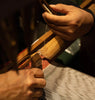
Su Embroidery: 2,000 Years of Chinese Craft Meets Modern Fashion
In a quiet workshop in Suzhou, a woman in her sixties sits at a wooden frame, threading a needle finer than a hair. She's been doing this since she was seven years old. Her hands move with a precision that no machine can replicate — each stitch placed with the kind of intention that can only come from a lifetime of practice.
This is Su embroidery. And it's been around for two thousand years.
Most people have never heard of it outside of China. But if you've ever looked at a piece of Chinese silk embroidery so detailed it looks like a painting, you've seen Su embroidery's influence. It's one of the four great embroidery traditions of China, and it's the craft that SunnySass built its entire brand around.
Let me tell you why.

What Is Su Embroidery?
Su embroidery originates from Suzhou, a city in Jiangsu province, eastern China. It's one of the oldest embroidery traditions in the world, with documented history dating back to the Three Kingdoms period (220-280 AD). That's nearly two millennia of continuous practice, refinement, and transmission from master to apprentice.
Su embroidery is known for four qualities that Chinese connoisseurs call fine, precise, elegant, and clean. The stitches are so small and dense that from a distance, the embroidery looks like a watercolor painting rather than thread on fabric. The thread can be split into fractions of its original thickness — a single silk thread divided into 1/2, 1/4, 1/8, even 1/16 — allowing for detail that approaches photorealism.
Traditional Su embroidery subjects include flowers, birds, fish, cats, and landscapes. The most prized pieces are double-sided embroideries, where the same frame displays two different images on each side, both flawless, with no visible knots or loose threads. These pieces can take months or even years to complete.
From Imperial Courts to Modern Wardrobes
For most of its history, Su embroidery was an art form reserved for the elite. Emperors commissioned embroidered robes. Noble families displayed embroidered screens and scrolls. The finest pieces were considered as valuable as paintings by master artists — because in a sense, they were. The embroiderer is the painter, the needle is the brush, and the silk thread is the pigment.
But like many traditional crafts, Su embroidery faced a crisis in the modern era. Machine embroidery became faster and cheaper. Young people moved to cities for factory jobs instead of apprenticing in embroidery workshops. The art form was at risk of becoming a museum piece — admired but no longer lived.
This is where the story gets interesting.
The Modern Revival
In recent years, there's been a push to bring traditional crafts into contemporary life. Not by putting them behind glass in a museum, but by finding new applications that make them relevant to modern consumers.
Some designers have incorporated Su embroidery into high fashion — think Dior-level runway pieces with hand-embroidered details that take hundreds of hours to complete. Others have applied it to accessories, home decor, and jewelry.
SunnySass took a different approach: what if we put Su embroidery on something everyone wears every day — a t-shirt?
Not a luxury blouse. Not a display piece. A t-shirt. Something you throw on in the morning, wear to work, go outside, and watch the embroidery transform in sunlight.

Why Su Embroidery for a T-Shirt?
You might wonder: why not machine embroidery? It's faster, cheaper, and more consistent. Why hand-stitch a million needles onto a t-shirt that costs $49?
Because machine embroidery and hand embroidery are fundamentally different experiences.
Machine embroidery is precise but flat. The stitches are uniform, the tension is controlled by a computer, and the result is clean but predictable. It looks good, but it doesn't have soul.
Hand embroidery has dimensional depth that machines can't replicate. The artisan controls the tension of each stitch, the angle of each thread, and the density of each section. The result is embroidery that catches light differently depending on how you look at it — it has texture, shadow, and movement. It feels alive.
And when you combine hand embroidery with photochromic thread — when the artisan decides exactly where the photochromic thread goes and where regular thread stays — the color change becomes part of the artistic vision, not just a technical effect.
The SunnySass Craft Process
Every SunnySass UV-Reactive T-Shirt goes through a process that bridges ancient craft and modern technology:
-
Design: Our designers sketch motifs inspired by nature and light — mountain peaks, ocean waves, forest canopies. They mark which areas will use photochromic thread and which will use regular thread.
-
Thread preparation: Artisans split silk threads to the desired thickness. A single design might use threads split to 1/4, 1/8, or even 1/16 of their original thickness, depending on the level of detail needed.
-
Mixed stitching: Photochromic and regular threads are stitched together in the same pass. The artisan knows exactly which sections will respond to UV light and which will remain color-stable. This isn't random — it's a deliberate artistic choice.
-
QC testing: Each finished piece is tested under UV light to verify the color change works as intended. Only pieces that meet our standards make it to production.
The entire process takes many hours per shirt. That's why each run is limited — we can't rush artisans who are placing a million needles by hand.
Why This Matters
Here's what I think is the most important part: when you wear a SunnySass shirt, you're not just wearing a cool color-changing t-shirt. You're wearing a piece of living cultural heritage.
The woman in the Suzhou workshop who stitched your shirt learned her craft from her mother, who learned it from her mother, in a lineage that stretches back two thousand years. Every stitch carries that history. Every needle placement reflects a tradition that has survived wars, revolutions, and industrialization.
And now it's on your chest, changing color in the sunlight, starting conversations with strangers who have no idea they're looking at two millennia of craft history.
That's not a marketing angle. That's the actual truth.
The Future of Traditional Craft
I don't believe traditional crafts survive by being preserved in amber. They survive by being used, worn, and integrated into modern life. Su embroidery isn't going to come back by being displayed in museums. It's going to come back by being on the shirts people wear to music festivals, to the beach, to brunch with friends.
Every time someone asks, "Wait, your shirt just changed color — how does that work?" and you get to tell them about Suzhou embroidery artisans and photochromic thread, the craft gets a little more visibility. A little more relevance. A little more life.
That's the future of Su embroidery. Not behind glass. On your back. In the sun.
Want to wear a piece of 2,000-year-old craft history? Our UV-Reactive Suzhou Embroidery T-Shirt at sunnysass.com combines ancient Su embroidery techniques with modern photochromic technology. One million hand-stitched needles per design. $49. And a story that starts the moment you step outside.
Billets de blog
-
, par Author Article title
-
, par Author Article title
-
, par Author Article title