
THE SUNLIT JOURNAL · UV REACTIVE GUIDE
Do Color-Changing Shirts Work on Cloudy Days?
Yes — but not necessarily in the same way they do under bright sunlight. The reason comes down to something more important than whether you can see the sun: how much UV light reaches the shirt.
The short answer
A UV-reactive T-shirt can still respond on a cloudy day because clouds do not completely block ultraviolet radiation.
But cloud cover can reduce the amount of UV reaching the garment, so the color change may be slower, softer or less noticeable than it is under strong direct sunlight.
Think of the effect as a spectrum rather than an on/off switch. More UV usually means a clearer reveal. Less UV usually means a subtler one.
UV
The trigger
is ultraviolet light,
not sunshine you can see.
A cloudy sky does not mean
zero UV.
This is the first thing to understand about sun-activated shirts.
The human eye sees visible sunlight, but ultraviolet radiation is different. Clouds can reduce UV levels, but they do not simply make ultraviolet light disappear.
That is why you can still receive UV exposure on an overcast day — and why a UV-reactive shirt can still respond even when the sky looks grey.
The important variable is not:
“Can I see the sun?”
It is:
“Is enough UV light reaching the reactive material?”
Overcast
Cloudy Day
UV is still present, but the amount reaching the shirt can be lower than under strong direct sunlight.
Expected: a softer or slower reveal.
Strong daylight
Sunny Day
Strong outdoor UV exposure generally creates a clearer and more obvious photochromic response.
Expected: a more visible reveal.

Same shirt. Different UV conditions. The intensity of the reveal can change with the weather.
What actually changes
from day to day?
A UV-reactive shirt does not have one universal “activation level” that looks exactly the same every time you wear it.
The visible result is influenced by the conditions around you.
01 UV intensity Stronger UV exposure generally creates a more noticeable response.
02 Exposure time More time under sufficient UV can allow the reactive areas to develop their visible color.
03 Season & time UV conditions change with season, latitude, weather and time of day.
04 Surroundings Shade, buildings, windows and nearby surfaces can all change the amount of UV reaching the garment.
Myth
vs.
Reality
vs.
Reality
“If there are clouds,
the shirt won't change.”
Not necessarily.
Clouds can reduce UV intensity, but they do not automatically eliminate it. Depending on the weather and the material, enough UV may still reach the shirt for the reactive areas to respond.
The result may simply be less dramatic than it would be under strong direct sunlight.
Why yesterday's reveal may
look different from today's
Imagine wearing the same shirt two afternoons in a row.
Yesterday is bright and sunny. Today is overcast.
The shirt has not suddenly “stopped working.” The environment has changed.
This is one of the most important things to understand about photochromic clothing: the color change is responsive to conditions.
That means the exact appearance can vary from one moment to another. The effect is better thought of as a response to UV exposure than as a fixed visual setting.
What about shade?
Shade and cloudy conditions are related, but they are not identical.
In deep shade, buildings, trees and surrounding structures can block much of the incoming UV. The reactive effect may therefore become very subtle.
In open partial shade, some UV can still reach the garment and produce a softer response.
That's why a shirt can sometimes appear to “come alive” when you move from under a tree into an open area — even though both places are technically outside.
And what happens through a window?
This is another reason indoor and outdoor experiences can differ.
Different types of glass filter different amounts of ultraviolet radiation. As a result, sitting beside a bright window is not necessarily equivalent to standing outside in natural daylight.
A UV-reactive T-shirt may therefore show little or no visible change indoors even when the room appears very bright.
For the clearest reveal, outdoor natural light remains the simplest environment to use as your reference.

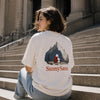
The reactive effect lives in selected embroidered details, not across the entire design.
The whole shirt doesn't need to change
Sunlit Peaks uses a selective approach rather than making the entire back graphic transform.
The main landscape stays stable while selected mountain peak details use UV-reactive embroidery thread.
That means the same artwork works in both states: quiet in shade and more expressive under stronger UV exposure.
The bear, blue-gray landscape, ground and SunnySass lettering remain in their original colors.
The shirt doesn't need perfect weather.
It only needs enough light to reveal another layer.
Want to see the clearest color change?
You don't need special equipment for everyday viewing.
For the most visible transformation, wear the shirt outdoors under bright natural daylight and give the reactive areas enough time to receive UV exposure.
Avoid judging the effect from a dim indoor room, deep shade or a heavily obstructed environment.
And remember: stronger and more direct UV does not mean “better” — it simply makes the reactive effect easier to see.

Designed for ordinary days. More visible when the sunlight finds it.
A few cloudy-day questions worth knowing
The short version:
- Clouds can reduce UV exposure, but they do not automatically eliminate it.
- A weaker UV environment can create a weaker or slower visible reveal.
- Deep shade can reduce UV further.
- A bright indoor room is not necessarily equivalent to outdoor sunlight.
- The visible effect naturally varies with conditions.
That variability is part of what makes sun-activated clothing different from a conventional printed graphic.
THE
SUNNYSASS
IDEA
SUNNYSASS
IDEA
We don't want the sun
to be a requirement.
A Sunlit Peaks tee should still be an embroidered graphic shirt when the weather is grey.
The sunlight-reactive details are simply another layer — a small visual surprise that appears when the conditions are right.
That's why the embroidery comes first. The sunlight comes second.
Frequently asked questions
Do color-changing shirts work on cloudy days?
Yes, they can. Clouds can reduce the amount of UV light reaching the garment, but they do not automatically eliminate UV exposure. The visible effect may therefore be softer or slower than it is under strong direct sunlight.
Do UV-reactive shirts need direct sunlight?
Not necessarily. The key factor is sufficient UV exposure rather than visible sunshine itself. However, bright natural outdoor light generally provides the clearest and easiest-to-see reveal.
Does a UV-reactive shirt work in the shade?
It depends on how much UV reaches the reactive material. Deep shade can make the effect very subtle, while open partial shade may still provide enough UV for some visible response.
Why does my color-changing shirt look different on different days?
UV intensity, exposure time, weather, season, time of day and surrounding conditions can all affect the visible strength and speed of a photochromic response.
Will a color-changing shirt work through a window?
The effect may be weaker indoors because different types of glass filter different amounts of UV. A bright room beside a window is not necessarily equivalent to being outdoors in natural daylight.
Does the whole SunnySass shirt change color?
No. On Sunlit Peaks, only selected mountain peak details use UV-reactive embroidery thread. The bear, landscape, ground and SunnySass lettering remain in their original colors.
Is the color change stronger on the white or black shirt?
The white tee generally creates the clearest visual transformation. The black tee has a more understated overall effect. The exact visible result still depends on UV intensity and exposure conditions.
Is UV-reactive clothing the same as glow-in-the-dark clothing?
No. UV-reactive or photochromic materials respond to ultraviolet exposure and change their visible color. Glow-in-the-dark materials store energy and emit visible light after the activating source is removed.
SUNLIT PEAKS · UV-REACTIVE EMBROIDERY
The sky doesn't have to be perfect.
Sunlit Peaks is designed to look complete in shade and reveal selected mountain details when sunlight finds them. One design. Two moods.
Explore Sunlit PeaksBillets de blog
-
, par Author Article title
-
, par Author Article title
-
, par Author Article title